

Planiseal LVB
$289.95
Covers 150 Sq. Ft per Gallon.
(No reviews yet)

Write a Review

Planiseal LVB
DESCRIPTION LIMITATIONS
Planiseal LVB is a two-component, very low-viscosity, epoxy healer/sealer designed to penetrate into new or worn cracked concrete surfaces. Planiseal LVB seals hairline cracks against further moisture penetration and chloride intrusion.
FEATURES AND BENEFITS
Very low viscosity for penetrating and filling the finest hairline cracks
Impedes the intrusion of moisture and chlorides
Easy to mix (1:1 ratio)
WHERE TO USE
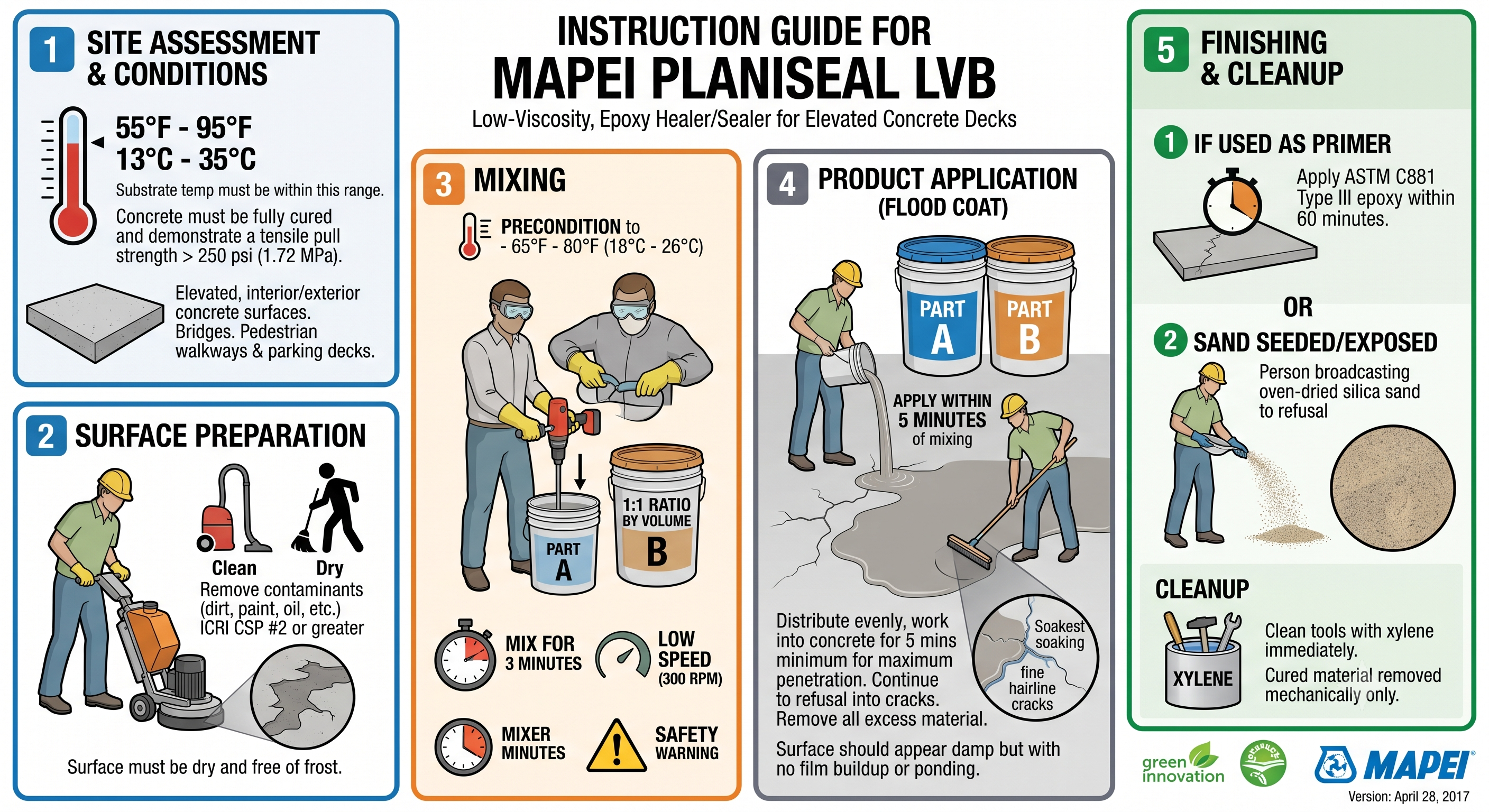
Use on elevated, interior/exterior concrete surfaces. Use on bridges.
Use on pedestrian walkways and parking decks.
Use as a primer before use of an ASTM C881 Type III epoxy.
• Substrate application temperature must be between 55°F and 95°F (13°C and 35°C).
• Application should not exceed more than one flood coat.
• Do not apply over curing compounds.
• Due to low viscosity of this material, it may penetrate through entire depth of crack. Precautions should be taken to protect areas below the deck.
• Product must be sand-seeded when left exposed.
SUITABLE SUBSTRATES
Fully cured and prepared concrete
Concrete substrates must demonstrate a tensile pull strength exceeding 250 psi (1,72 MPa).
Consult MAPEI’s Technical Services Department for installation recommendations regarding substrates and conditions not listed.
SURFACE PREPARATION
Mechanically prepare to an International Concrete Repair Institute (ICRI) concrete surface profile (CSP) of #2 or greater.
Surface must be dry and free of frost.
Repair spalls, delaminations, potholes and cracks with a suitable MAPEI repair product before the application of Planiseal LVB.
Low-Viscosity, Epoxy Healer/Sealer for Elevated Concrete Decks
Planiseal LVB is a two-component, very low-viscosity, epoxy healer/sealer designed to penetrate into new or worn cracked concrete surfaces. Planiseal LVB seals hairline cracks against further moisture penetration and chloride intrusion.